TREE PRUNING METHODS & TYPES – IN DETAIL
Pruning your trees has many different benefits, including keeping them healthy and strong. While it may seem counterproductive, cutting off large, heavy branches or diseased limbs can help your tree recover and make it even more disease-resistant. Still, most homeowners don’t take the time to research professional tree trimming or pruning until it’s too late. In fact, many don’t call Weekend Tree Removal until limbs are lying in the lawn after a bad storm. However, any one of the following types of tree pruning could have prevented the extra damage or head ache.
There are eight primary types of tree trimming that arborists use to achieve the desired pruning objective:
• Crown cleaning
• Crown thinning
• Crown raising
• Crown reduction
• Crown restoration
• Espalier pruning
• Vista pruning
• Pollarding
Dead-wooding, or Crown cleaning
Dead-wooding, or Crown cleaning is the most basic level of tree pruning and includes the removal of dead, dying, diseased and broken branches. Most arborists have been trained from the first time they picked up a saw to remove these types of branches without hesitation. Removing all of the dead branches lowers the risk of injury to you and your home.
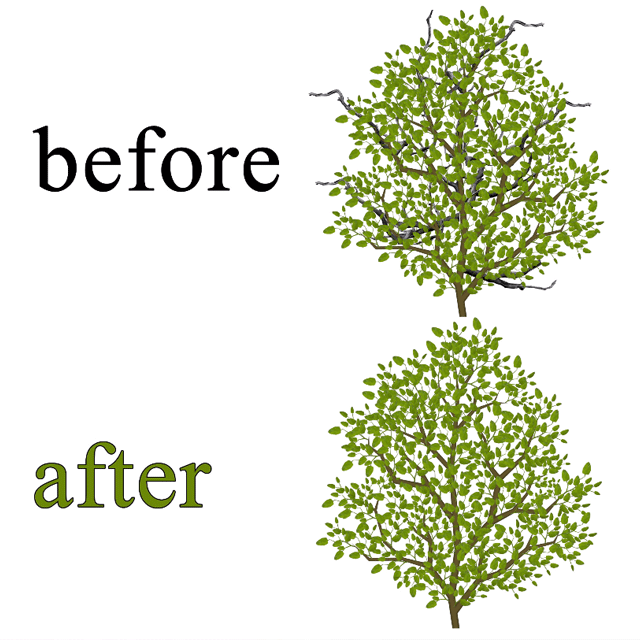
An example of a crown cleaning specification might be, “crown clean to remove dead, dying and broken branches 1” diameter or larger”.
Crown Thinning
Crown thinning is the selective removal of branches to increase light penetration and air movement through the crown of the tree. Crown thinning opens up the foliage of a tree, reduces weight on heavy limbs and helps retain the tree’s natural shape. In most cases, no more than one-fourth of the live foliage should be removed when thinning a tree. Crown thinning also lightens larger limbs’ loads, lowering the risk of losing bigger branches in a spring thunderstorm.

When crown thinning is necessary the arborist might write, “crown thin to remove excess interior branches ½” diameter or larger”.
Crown Raising (lifting)
Crown raising consists of pruning or removing lower branches or limbs to provide vertical clearance. Crown raising also allows for your trees to match the rest of your landscaping, leaving them both well-manicured and healthy.
This process is usually done for trees that overhang sidewalks, roads, or even your home. Distances from objects to be cleared, or heights above ground level lets the pruning arborist know how much of the lower canopy or how many lower branches need to be pruned from the tree. However, this process can be harmful to larger, more mature trees, making it a process intended for younger trees. Crown raising might be done on the entire bottom of the crown or only one portion of the crown.
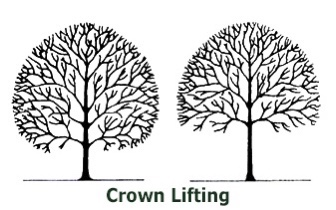
A crown raising specification could be given as, “crown raise entire lower canopy to 8 – 10’ above ground level”.
Crown Reduction
Crown reduction is used to clear tree branches from objects such as buildings, signs or lights. Crown reduction pruning is also utilized to reduce the canopy of the tree in an effort to decrease the height and/or spread of the canopy. Branch tips are cut back to lateral branches that can take over as the terminal point of growth. By removing small branches attached to the larger, heavier branches, crown reduction ensures that your trees don’t become too top-heavy. This type of pruning is especially crucial for younger trees, and helps promote the young tree to continue to grow big and strong without all the added weight of smaller branches. This is different from tree topping, which is simply cutting back branches at random points or preassigned distances in the tree with little regard to the remaining branch or the presence or location of lateral branches.

Crown reduction pruning should state what object the branches are being cleared from and how far they should be pruned back, such as, “crown reduce to establish 3 – 5’ clearance from house”.
Crown Restoration
Crown restoration is usually the necessary type of pruning for trees that have sustained damage from storms or have been vandalized. Branches may be cut back to smaller than normal sized lateral branches in the hope that the tree will retain, or eventually regain, its natural form and appearance.
A crown restoration specification can vary quite a bit depending on the tree species being pruned and the type of damage that has occurred. An example might be stated as, “crown restore by removing weak or broken branches back to lateral branches that are at least 1/3 the diameter of the parent limb”.
Espalier Pruning
Espalier pruning is rarely seen on this side of the Atlantic Ocean, but was common in Europe where small courtyards could accommodate trees if they were pruned to stay tight against a wall. Espalier pruning requires quite a bit of time and effort, but the resulting plant is almost always attractive and eye-catching.

I’ve never had to write a specification for espalier pruning, but if I did it might go something like this, “prune all non-horizontal growth to maintain current, horizontal branching habit’.
Vista Pruning
Vista pruning is used to prune or remove branches to improve the view of scenery or an object from a predetermined point. Vista pruning might involve removing whole branches or it could require thinning, or maybe over-thinning, a selected portion of the tree canopy.

Pruning specifications for vista pruning will depend largely on what view is trying to be obtained, but could be as simple as, “when looking from the patio, remove the lowest branch on the left side of the tree back to the main trunk and remove the three lowest branches on the right side of the tree back to the main trunk to improve the view of the lake”.
Pollard Pruning
Pollarding involves removing all branches so that all that remains is a framework of the secondary branches along the main stem. Pollarding begins when your trees are still young and is done at regular intervals during their lifespan. This type of trimming provides a constant supply of small diameter poles without killing your tree. It is sometimes done today for aesthetic purposes—the resulting “lollipop trees” or “lions tail” can be appealing to those who crave horticultural oddities

Pruning specifications for pollarding is remove upper and outer branch to create dense foliage for next years growth.
Tree care matters to us
Tree care and pruning is an essential part of homeownership. If your trees haven’t been pruned in a while, it’s time to call the professional team at Weekend Tree Removal. Not only can we prune your young or mature trees, but we can also treat them for diseases. We proudly serve residents throughout Rostraver, and the Greater Pittsburgh areas. To get a free tree pruning estimate, give us a call today at 724-550-6448.
 Weekend Tree Care